
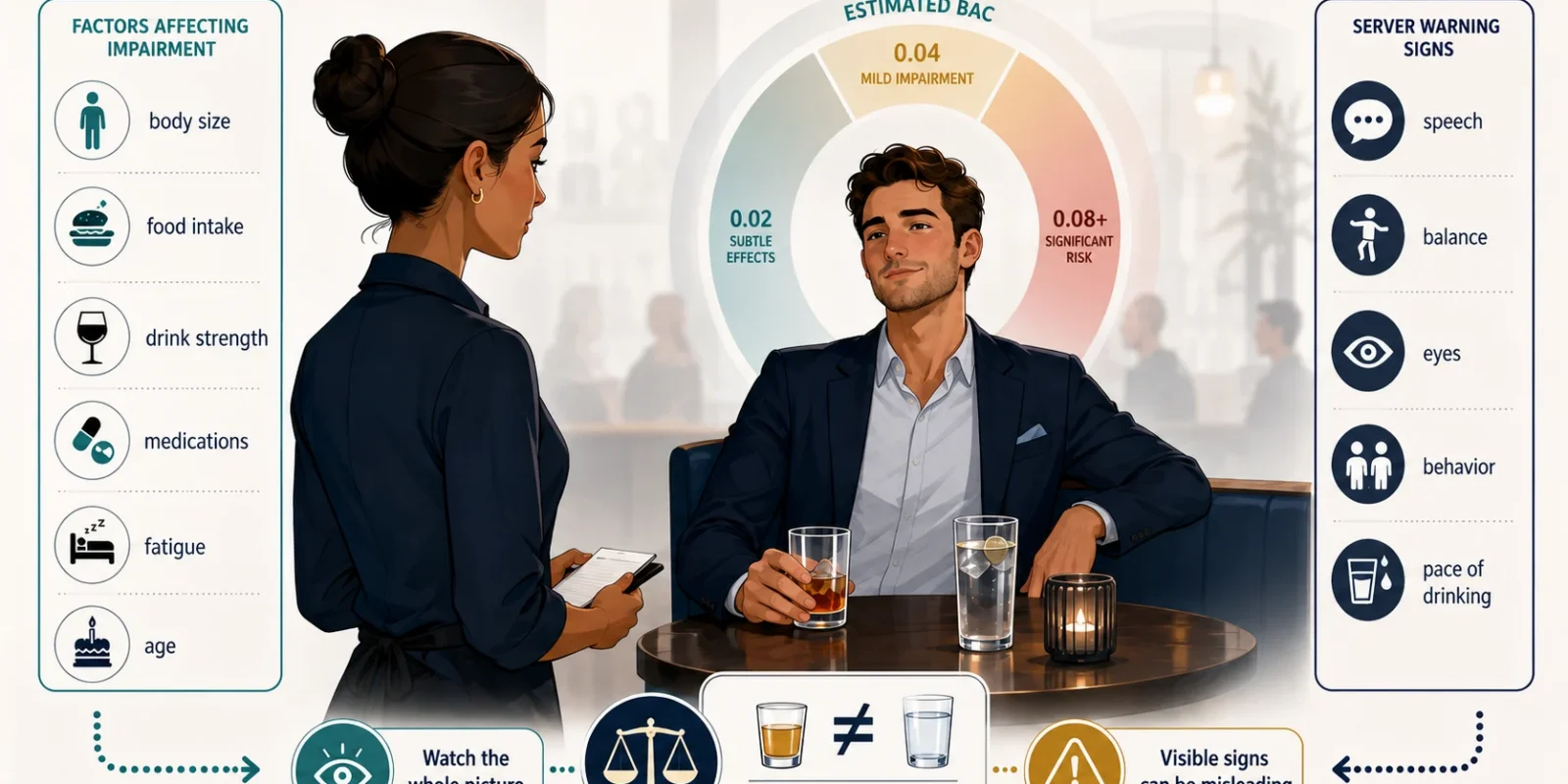
The responsibility of serving alcohol is more than simply taking an order and then delivering the drink. Servers require education, preparedness and often subjective judgment about patron safety as well as legal compliance. They must also know when to stop service to a patron who may seem unruly or overly intoxicated. One of the most misunderstood components in this line of work is alcohol tolerance.
You might think that it would be easy to assume that a person who can “hold their liquor” is less impaired or less of a risk to serve. That’s not often the case. In reality, alcohol tolerance can make it more difficult to spot a patron who may be overserved and on the verge of posing the type of risk that alcohol server training aims to prevent. There is no perfect measurement for alcohol tolerance, which is why understanding alcohol tolerance is important for servers.
What Alcohol Tolerance Really Means
Alcohol tolerance refers to a reduced observable response to alcohol after repeated exposure. Just because someone you’ve been serving might appear relatively sober doesn’t mean that alcohol is not in their system. One possibility for their sober appearance and demeanor is that they do have a higher alcohol tolerance, but they may also be hiding the fact they’re impaired or the effects of the alcohol may be delayed. A sober appearance at a bar or table does not mean that their judgment, reaction time or coordination are not affected to some degree by the alcohol they consumed.
Most are familiar with the term BAC, or blood alcohol concentration. In most U.S. states, the general legal limit for driving is a BAC of 0.08%; Utah’s limit is 0.05%. That is a legal threshold for driving, not a standard for determining a person’s alcohol tolerance. However, federal safety sources, including the Center for Disease Control and Prevention, suggest that measurable alcohol impairment starts at lower BAC levels. Impairment under the legal limit tops the list of reasons as to why servers should understand alcohol tolerance.
Tolerance Does Not Mean Sobriety
A patron with high tolerance may be able to speak clearly and appear more composed than others with the same BAC. However, that familiarity with impairment or tolerance to alcohol does not mean that they are sober.
Tolerance can mask early signs of impairment. A seasoned server will tell you that drink counts alone are not enough and that visible presentation can often be misleading when it comes to understanding how tolerant a patron may be. Drink counts are an especially unreliable indicator since a patron may have arrived already intoxicated.
Factors That Can Affect BAC and Impairment
One simple trick of the trade is understanding that the same number of drinks can affect people differently. Professional servers are generally aware that body size, sex, food intake, drink strength, medications, fatigue and age are all contributing factors when it comes to how much a person may be impaired. Also, some cocktails are obviously stronger than others. A patron saying that he or she has had only two drinks is not enough to estimate their intoxication level.
Eating can slow alcohol absorption, but food does not ‘sober up’ a patron or remove alcohol already in the bloodstream. This is because the alcohol is already in the bloodstream. The only factor that lowers your BAC is time and that can work against a patron who is being stubborn or choosing to continue alcohol consumption. For a server, the key lesson is that tolerance is only one variable among many when it comes to determining the level of a patron’s true impairment.
What Should Servers Look For?
Alcohol tolerance looks different for everyone. However, a well-trained server will know how to focus on patterns rather than a single cue. These signs might include slurred speech or louder-than-normal speech. Repetition in speech can also be a sign. Delayed responses, glassy or bloodshot eyes and loss of balance are also strong indicators that someone has exceeded their alcohol tolerance. Also, a server should be mindful of drink spillage, inappropriate suggestions or aggression, poor judgment and a shift from what would be considered a calm state to an aggravated or emotional frame of mind.
Servers should also keep an eye on how fast the guest is drinking. Two cocktails over the course of an hour may affect patrons differently, but three shots in 20 minutes can indicate rapid consumption. Servers should be trained to take in the whole picture and that will relieve some of the pressure of making judgment calls on sobriety that can be affected by tolerance.
Understanding Alcohol Tolerance Can Save a Life and Even a Career
Misunderstanding alcohol tolerance can lead to overservice. Overservice can put you and your employer at risk for civil liability under Dram Shop Laws, which vary by state, as well as criminal or administrative penalties under other applicable laws . With modern technology, it’s easier than ever to prove fault when a professional has been accused of acting unlawfully while serving alcohol. Even when legal standards vary, the expectation is the same: servers must observe, intervene and refuse service when necessary. The legal and professional stakes are high if an impaired patron leaves your establishment and causes harm or even death. Your interpretation of someone’s tolerance can have a direct impact on your finances and freedom.
Are you a business owner who is looking to protect his establishment from civil or legal violations due to overserving? One of the most effective ways to do this is to make sure that your staff is properly trained and certified.
American Course Academy offers alcohol server and sales training in an expanding number of states. Our state-approved courses are 100% online and can be completed from any internet-connected device. All of our courses are offered in English and Spanish. View our currently supported states for alcohol service training here and get started today.