
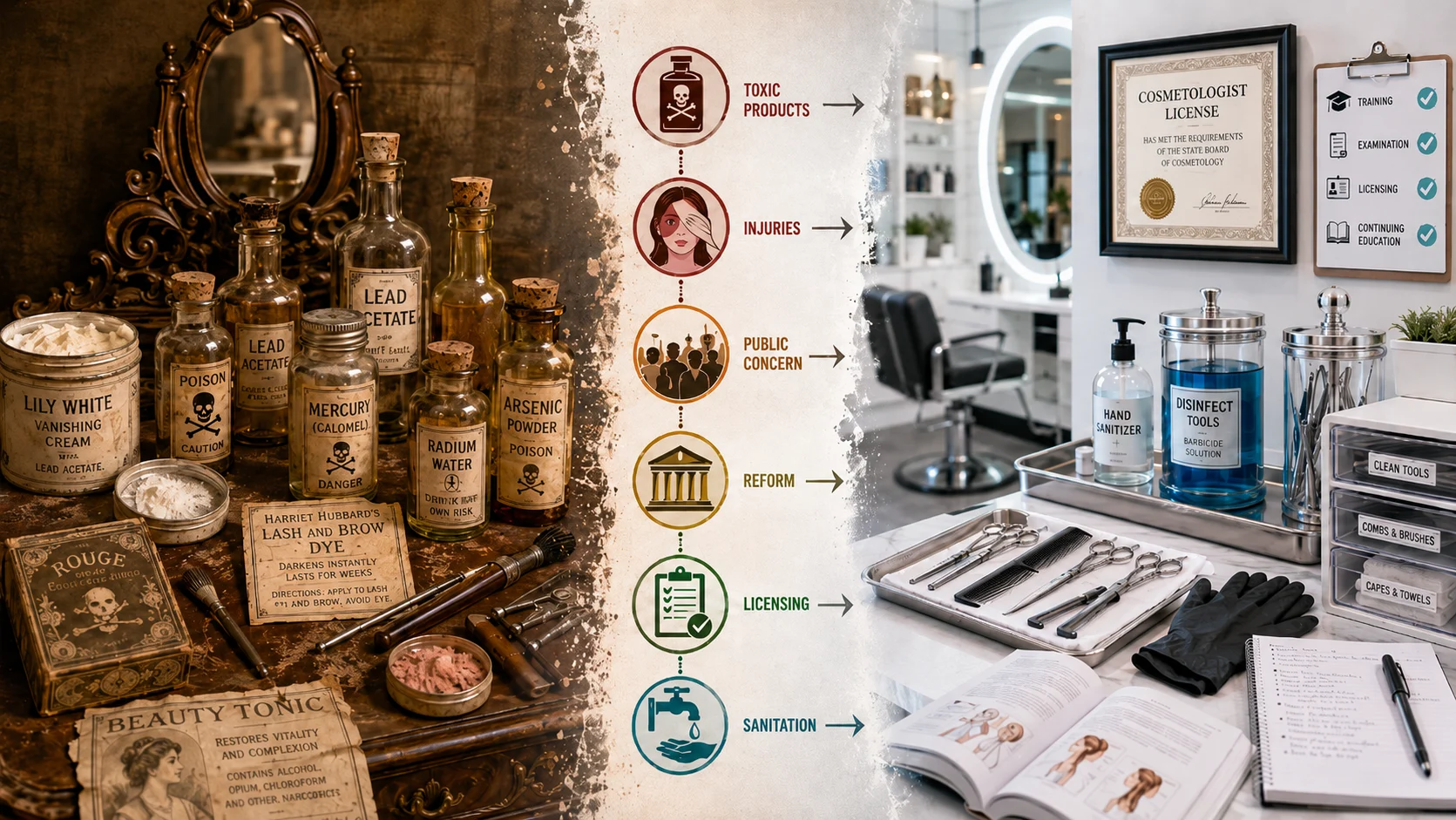
Cosmetology sanitation laws didn’t come into existence without cause. Present-day laws were shaped by centuries of dangerous beauty practices as well as public health disasters and growing demand for consumer protections across the board.
For much of our history, people used cosmetic products with little to no scientific testing and almost no legal oversight. Many beauty products were often made at home. Traveling vendors also put together unusual or outrageous concoctions and promoted them with extravagant and mostly unfounded claims. Promises of continued youth, pale skin and even permanent hair removal were made without any regulatory body to verify these claims or check the safety of the products. Often those products would contain toxic chemicals such as lead, mercury, arsenic and, in some cases, radioactive materials. It was a mighty mess for consumers because there were neither protections provided nor penalties applied when it came to the immoral production and sale of those beauty products.
The dangerous beauty practices that led to modern cosmetology laws do have one benefit, however: they are interesting to review in hindsight.
Early Regulations in the History of Cosmetology Laws
Cosmetology products containing poisonous substances first drew attention from early regulators. Believe it or not, for centuries pale skin was considered to be a symbol of wealth and status. This led many of those profit-driven vendors and manufacturers to add whitening ingredients such as white lead and arsenic to their beauty products. This would result in skin damage, hair loss and anemia. Prolonged use even resulted in neurological damage and even death.
As if those dangerous beauty practices weren’t enough, mercury compounds were also used in skin creams and complexion treatments. They were added to remove freckles and, again, lighten skin. Mercury is no friend to your kidneys and, in time, many realized how this chemical element could wreak havoc on your nervous system.
Many women of the time were made aware of these dangers. However, the risks were often thought to be minimal. Social pressure and beauty ideals ruled the moment. Consumers really didn’t have a way to properly test the products and generally didn’t feel the need to.
The Rise of Mass-Produced Cosmetics
In the late 1800s and early 1900s, cosmetics were produced on a mass scale. Now, those highly poisonous products were reaching millions, which quickly helped build momentum to introduce new cosmetology sanitation laws.
In 1933, a product called Lash Lure was released as an eyelash and eyebrow dye. It contained a coal-tar derivative which, you may presume, is not a wise compound to place near your eye. This resulted in severe eye injuries, blindness and one known death. Radioactive beauty products soared in popularity due to an early fascination with radium’s potential. Koremlu was also a beauty product that contained highly toxic chemicals such as a form of rat poison called thallium acetate. This compound was so toxic that thallium was eventually banned for use in U.S. pesticides and rodenticides. Now that’s saying something.
Cosmetic injuries were not just rare accidents and they were not simply a matter of routine consumer misuse. They were literally symptoms of an out-of-control industry operating faster than the law could respond.
The Federal Response
Before major federal reform, federal law offered weak protection against dangerous cosmetics. There was the Pure Food and Drug Act of 1906, but its primary focus was on food and drugs. It wasn’t designed with the cosmetic industry in mind.
The FDA tried to do its part by warning consumers of the dangers of specific cosmetic products. This was presented by way of a traveling exhibition that was often referred to as the “Chamber of Horrors.” This public campaign, combined with an ever-growing list of widely reported injuries, helped to build support for stronger regulations. In 1938 the Federal Food Drug and Cosmetic Act became America’s first true effort to curb dangerous beauty practices. It is historically important because this act finally brought cosmetics under federal oversight and prohibited the introduction of adulterated or misbranded cosmetic products into interstate commerce.
Modern Cosmetology Laws and Effects
The 1938 act strengthened federal oversight of cosmetic products. Separately, state cosmetology laws increasingly established training, licensing and sanitation requirements for salons and beauty schools. Cosmetology sanitation laws also help to determine not only what products were sold but who was allowed to sell them and under what conditions.
This remarkable shift in the industry was a direct reflection of those previously dangerous beauty practices. As a result, safety is no longer dependent on consumer judgment or false promises and practices. Training, inspection and accountability are now required across the board. This helped reduce harmful practices and birthed the massive cosmetology industry that flourishes before us today.
If you are looking for a place in this booming industry and require training or certification, then you’re exactly where you need to be. American Course Academy provides state-approved cosmetology training for a growing number of states. Our cosmetology CE is remarkably affordable and can be completed anywhere you are with a Wi-Fi-enabled device. View our available cosmetology CE and enroll today.