
When it comes to the crossroads of American History and the laws of our free lands, it’s hard to overlook the still lingering impact of Prohibition on both a national and state level. Like any law that is established and then abolished, chaos reigned when Prohibition was repealed in 1933. The effects of which can be observed in modern laws and regulations in various ways across states, with Florida being one of the more interesting examples. Here’s how Prohibition shaped Florida’s three-tier alcohol system.
Prohibition in Florida
Like most states, Prohibition didn’t make booze disappear in the Sunshine State. Prohibition in Florida simply meant that the sales and consumption of booze went underground. Organized crime took over the supply chains. Sellers, transporters and even consumers all operated easily and happily outside of the law.
Because of Florida’s easy access to the Caribbean, an entire legion of “rumrunners” operated up and down the state’s lengthy coastline. Smuggling routes flourished. Speakeasies thrived. Big cities like Miami and Tampa made it all the more difficult for lawmen to track these illegal operations.
Between 1920 and 1933, incomes and sometimes fortunes were made by those Nayer-do-well bootleggers who ran amok on both roads and waterways. Rather than killing the booze business, Prohibition in Florida created a thriving underground market. The feds clearly struggled with enforcement and states like Florida were even less equipped to respond.
Post Prohibition in Florida
Once it was apparent that Prohibition’s end was near, the idea of legalized booze did not sit well with those underground operators. With the passage of the 21st amendment in 1933, states were once again handed the authority to properly regulate the sales and distribution of alcohol. Those rumrunners were suddenly out of business.
State lawmakers quickly understood that they had a problem. There was an immediate need to tighten oversight and clear accountability at every conceivable level of distribution. Florida, like other states, realized the difficulty of the task before them. This is why the Sunshine State took care when it came to developing its three-tier alcohol system. Control needed to be immediately and effectively established. So, what is Florida’s three-tier alcohol system?
The Elements of Florida’s Three-Tier Alcohol System
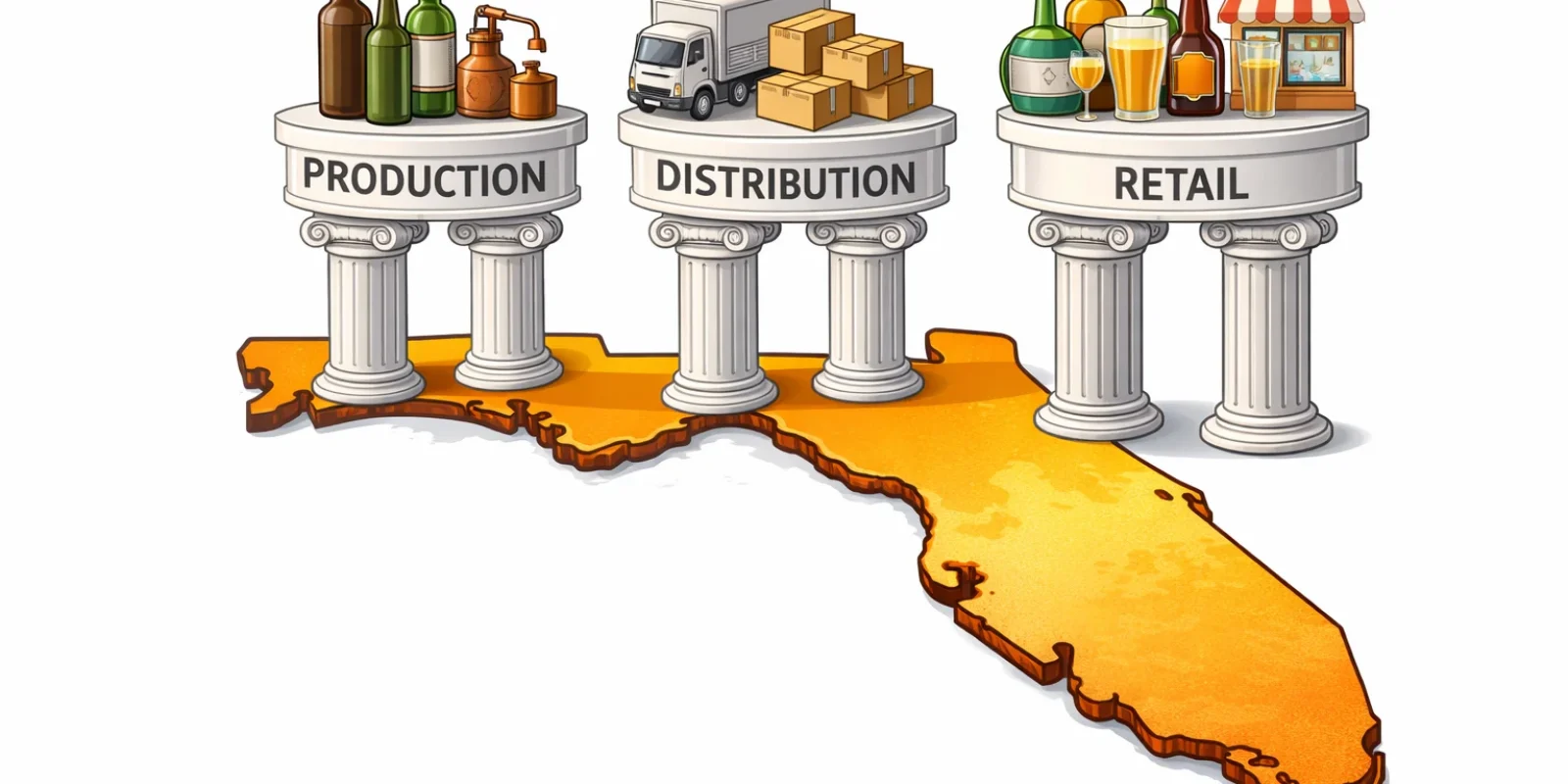
Florida’s three-tier alcohol system was specifically designed to prevent the abuses that so many witnessed during the course of Prohibition in America. The idea was to separate the alcohol industry into three distinct tiers. Florida’s three-tier alcohol system also called for immediate transparency and accountability with each tier in mind. It then empowered local governments to oversee all sales and collect all taxes due from each tier. To understand the system, we must have an introduction to those three tiers of production, distribution and retail.
Production presents a relatively wide but predictable range of elements. This includes those who manufacture and import booze into Florida. Distribution puts a strong emphasis on wholesalers and retail focuses on bars, stores and restaurants. The point of creating this three-tier alcohol system was to prohibit one tier from owning or controlling the others. It’s not too unlike the creation of our own three-branch government which was specifically designed to provide for a stronger system of “checks and balances.”
The Adoption of the Three-Tier Alcohol System
This three-tier alcohol system was implemented just after the repeal of Prohibition. The Florida Division of Alcoholic Beverages and Tobacco was then established to oversee all licensing as well as enforcement and compliance. One of the first directives was to make sure that there was enough tax revenue generated to properly fund the operations of this new law.
Taxes were quickly generated by way of putting an accountable eye on all licensing and retail sales of alcohol. All transactions, from one tier to the next, were to be documented for the purpose of taxation. This also helped regulators more effectively note or trace the source of illegal operators and penalize those violators accordingly.
The Effects, Regulation and Safety of a Three-Tiered Alcohol System
Florida’s three-tiered alcohol system is a direct reflection of the state’s commitment to both economic development and public safety. By weeding out rogue elements and collecting those taxes needed, Florida was able to create a sustainable and efficient model for both regulation and safety. Business was soon booming while state-funded programs reminded venues and patrons alike how to create and foster a safer environment for consuming alcohol.
From a regulatory standpoint, the three-tiered alcohol system proved to be a very effective way to properly monitor and control the flow of alcohol. It also allows for the enforcement of state laws regarding public health and overall safety. It even allows local communities to further their own rules and regulations as it regards the distribution and sale of alcohol. Sure, there are many who still debate the fairness of Florida’s three-tiered alcohol system, but it’s clear that this is an efficient program that provides for statewide balance and accountability.
If you’re looking to acquire or renew your FRVP certification for handling alcohol in the state of Florida then look no further. Our state-approved Florida Responsible Vendor Program (FRVP) can be completed from registration to certification in under two hours.
Once your remote training is completed, you can immediately download your certification for printing and display. American Course Academy is also proud to offer this course in both English and Spanish. Enroll today!